Freelancer or Side Hustler? 5 Steps to Get Your 1099 Taxes Right (Easy Guide for 2026)
- Sofy tax

- Feb 10
- 5 min read
What exactly is 1099 income and do I need to report it?
If you're freelancing, driving for Uber, selling on Etsy, or earning money through any side hustle, you're receiving 1099 income. Here's what matters: you must report all freelance and gig income on your tax return, even if you never receive a 1099 form.
Many freelancers mistakenly believe they only need to report income if they get a form in the mail. That's not true. Whether you earned $500 or $50,000, the IRS expects you to report every dollar. Think of 1099 forms as helpful reminders, not permission slips to report income.
The bottom line? Keep track of everything you earn. Your payment apps, invoices, and bank statements are your proof.
What are the different types of 1099 forms I might receive in 2026?
You'll likely encounter two main types of 1099 forms:
1099-NEC (Nonemployee Compensation): Clients who paid you $2,000 or more for services in 2026 will send you this form. If you did graphic design work for a company and they paid you $3,000 total throughout the year, expect a 1099-NEC.
1099-K (Payment Card and Third Party Network Transactions): This one comes from payment processors like PayPal, Stripe, Square, or Venmo. For 2026, the reporting threshold is $2,000 in transactions. This is a significant change from previous years.
Here's something crucial to understand: the 1099-K reports gross receipts before fees, refunds, and chargebacks. That means the number on the form might be higher than what you actually took home. You'll need to reconcile it with your own records to show the IRS your true income.
Do I really need to track income if it's under the 1099 reporting threshold?
Yes, absolutely. This is one of the biggest mistakes freelancers make.
Just because PayPal doesn't send you a 1099-K for $1,500 in transactions doesn't mean that income disappears from the IRS's perspective. You're legally required to report it. The same goes for cash payments, Zelle transfers, checks, or any other form of payment that doesn't generate a 1099.
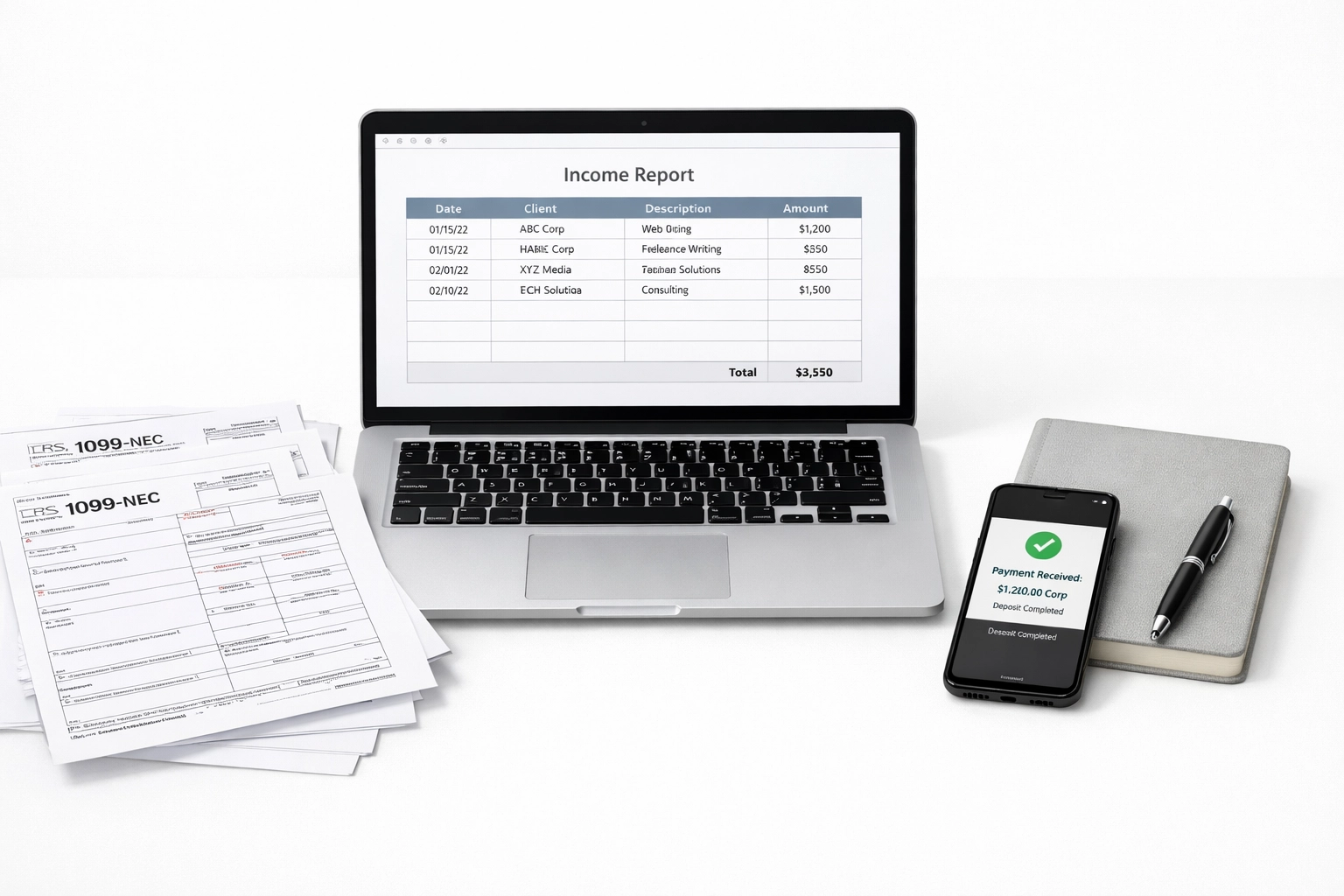
Start simple: create a spreadsheet or use accounting software to log every payment you receive. Include the date, client name, amount, and payment method. Reconcile this with your bank statements and payment processor records at least quarterly. When tax season arrives, you'll have everything organized instead of scrambling through emails and bank statements at midnight.
What business expenses can I deduct as a freelancer in 2026?
Deductions are where freelancers can save serious money. You're allowed to subtract business expenses from your income, which lowers your taxable income and your tax bill.
New deductions for 2026:
Tips deduction: Up to $25,000 annually if you work in a tipped occupation
Overtime pay deduction: Up to $12,500 for single filers ($25,000 if married filing jointly) if you worked over 40 hours per week
Auto loan interest deduction: Up to $10,000 for U.S.-assembled vehicles (income restrictions apply)
Standard business deductions you shouldn't miss:
Home office expenses (but the space must be used exclusively for business)
Internet and phone bills (prorated for business use)
Software subscriptions and tools
Professional development and courses
Mileage for business travel
Marketing and advertising costs
Professional services like accounting or legal fees
And here's a big one: the Qualified Business Income (QBI) deduction lets you deduct up to 20% of your qualified business income after expenses. This alone can save thousands of dollars.

How much will I owe in self-employment taxes?
This surprises many first-time freelancers. Beyond regular income tax, you owe self-employment tax of 15.3% on your net earnings. This covers Social Security and Medicare taxes.
When you work a traditional job, your employer pays half of these taxes and withholds the other half from your paycheck. As a freelancer, you're both employer and employee, so you pay both halves.
Here's the math: if you earn $50,000 in net self-employment income, you'll owe approximately $7,650 in self-employment tax, plus your regular income tax. This catches people off guard if they're not prepared.
The solution? Set aside 25-30% of every payment you receive for taxes. Put it in a separate savings account and don't touch it until tax time.
Should I take the standard deduction or itemize my taxes?
For 2026, the standard deduction increased to $15,750 for single filers and $31,500 for married couples filing jointly. This benefits 85-90% of freelancers.
Here's how to decide: add up all your potential itemized deductions (mortgage interest, state and local taxes, charitable contributions, medical expenses). If that total exceeds your standard deduction amount, itemize. If not, take the standard deduction.
Most freelancers find the standard deduction saves more money and requires far less paperwork. Your business expenses are separate: you deduct those on Schedule C regardless of whether you itemize or take the standard deduction.

What happens if I don't receive a 1099 form by the deadline?
Forms should arrive by January 31st, but sometimes they don't. Maybe a client went out of business, changed addresses, or simply forgot.
Don't wait. File your taxes using your own records. You know how much you earned: use your invoices, payment confirmations, and bank statements to calculate your income accurately.
If a 1099 arrives later and doesn't match what you reported, you can file an amended return. The key is meeting the tax filing deadline (April 15th for 2026) regardless of whether forms arrived.
How do I make quarterly estimated tax payments?
Since no employer withholds taxes from your freelance income, the IRS expects you to pay taxes throughout the year in quarterly installments.
2026 quarterly deadlines:
Q1: April 15, 2026
Q2: June 16, 2026
Q3: September 15, 2026
Q4: January 15, 2027
Calculate your estimated taxes by estimating your annual income, deductions, and tax liability. Divide by four and pay that amount each quarter. The IRS Form 1040-ES worksheet walks you through the calculation.
Missing quarterly payments results in penalties and interest, even if you pay everything by April 15th. Stay on schedule.
Can I get help filing my 1099 taxes without going to an office?
Absolutely. Tax preparation has evolved, and you no longer need to sit in an office for hours with boxes of receipts.
At Sofytax, we specialize in helping freelancers, side hustlers, and small business owners navigate 1099 taxes: all from the comfort of your home. We understand the unique challenges of self-employment income and know exactly which deductions you qualify for.
Our process is simple:
Upload your documents securely
Meet with a tax professional via video call
Get your taxes filed accurately and maximize your refund
¿Hablamos Español? We offer bilingual services to ensure you're comfortable discussing your tax situation in your preferred language.
Stop stressing about 1099 forms, deductions, and quarterly payments. Let professionals handle the complexity while you focus on growing your business. Your tax situation is unique, and cookie-cutter software often misses deductions that could save you hundreds or thousands of dollars.
Schedule your appointment today and experience how easy tax season can be when you have the right support. We're here to help you keep more of what you earn.
Comments